
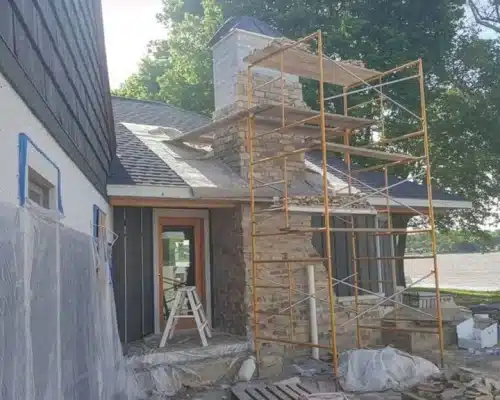
A masonry chimney takes more abuse than almost any other part of your home. It’s exposed on all sides, sits above the roofline where wind and weather hit hardest, and goes through more freeze-thaw cycles than your foundation or exterior walls. Small problems that start at the top of the chimney rarely stay small. Here’s what to look for, and why catching these signs early can save you from a full rebuild later.
Quick Reference: 8 Warning Signs
- Crumbling or missing mortar joints between the bricks
- Spalling bricks with flaking or chipped faces
- A leaning or separating chimney structure
- A cracked or damaged chimney crown at the top
- A missing or damaged chimney cap
- Deteriorated flashing where the chimney meets the roof
- White staining (efflorescence) on the brick
- Water stains on ceilings or walls near the chimney chase
If you’re noticing any of these, a professional chimney assessment can tell you whether you’re looking at a simple repair or something more involved.
Why Chimney Damage Shouldn’t Wait
Chimneys deteriorate faster than most homeowners expect, and the Quad Cities climate is a big part of why. Water gets into small cracks in mortar joints or brick, freezes, and expands. When it thaws, the crack is a little bit wider than before. Repeat that cycle through an Iowa or Illinois winter, and even a chimney that looked fine in October can show real damage by spring.
Because chimneys sit above the roofline, damage there doesn’t stay contained to the chimney itself. Water that gets past a cracked crown or failed flashing travels down into the attic, ceiling, and walls below—often causing interior damage well before a homeowner notices anything wrong outside. Catching these signs early is almost always the difference between a repair measured in hundreds of dollars and one measured in thousands.
Signs You Can See From the Ground
1. Crumbling or Missing Mortar Joints
Mortar is designed to wear out before the brick does—it’s the sacrificial layer that protects your chimney’s structure. Look for joints that are receding, crumbling, or missing chunks of mortar entirely. If you can scrape mortar out of a joint with a key or a screwdriver, it has likely broken down past the point of being weatherproof. This is usually addressed with tuckpointing, which is one of the most common and cost-effective chimney repairs there is—as long as it’s caught before the brick itself starts to fail.
2. Spalling Bricks
Spalling happens when water gets into the brick itself, freezes, and forces the face of the brick to flake, pop, or peel away. You’ll often see small chips or flakes of brick at the base of the chimney, or noticeable rough, pitted patches on the brick faces. Spalling is a sign that water has already penetrated the masonry, not just the mortar joints, and it tends to accelerate once it starts.
3. A Leaning or Separating Chimney
A chimney that visibly leans away from the house, or shows a gap opening up between the chimney and the exterior wall, is showing a structural problem—not just a cosmetic one. This is often caused by a settling or undersized foundation beneath the chimney, and it’s one of the few signs on this list that warrants a prompt assessment rather than waiting for a convenient time.
Signs at the Top of the Chimney
4. A Cracked or Damaged Chimney Crown
The crown is the concrete or mortar cap covering the top of the chimney around the flue, and it’s built to slope so water runs off rather than pooling. Cracks in the crown let water directly into the chimney structure, where it works its way down through the brick and mortar below. Because the crown takes the most direct weather exposure of any part of the chimney, it’s often the first component to fail.
5. A Missing or Damaged Chimney Cap
The cap is the metal cover over the flue opening itself. Without it, rain and snow fall straight into the chimney, and animals can nest inside. A missing or rusted-through cap is an easy visual check from the ground—if you can see straight down into the flue opening, or the cap looks bent, rusted, or absent, water is getting in every time it rains.
6. Deteriorated Flashing
Flashing seals the joint where the chimney passes through the roofline. It’s one of the most common sources of roof leaks, and homeowners frequently mistake flashing failure for a roofing problem rather than a chimney one. Look for rust, gaps, or lifted metal where the chimney meets the roof shingles.
Signs You Might Notice Inside Your Home
7. White Staining (Efflorescence)
Efflorescence is the white, chalky deposit that forms when water moves through masonry, dissolves mineral salts inside it, and leaves them behind as it evaporates at the surface. It’s not mold and it isn’t harmful by itself, but it’s reliable proof that water has been passing through your chimney’s brick. The more efflorescence you see, the longer the moisture problem has likely been going on.
8. Water Stains on Ceilings or Walls Near the Chimney
This is often the first sign homeowners actually notice, because it shows up inside the house rather than on the roof. A brownish stain on the ceiling near where the chimney passes through, or on an interior wall the chimney runs alongside, usually traces back to a failure at the crown, cap, or flashing above. By the time water is visible inside, it’s typically been entering for a while.
What Happens If You Ignore These Signs
Chimney problems are progressive. A small mortar joint issue that would cost a few hundred dollars to tuckpoint today can turn into brick that needs full replacement in a year or two if left alone. Water that keeps entering through a cracked crown or failed flashing doesn’t just damage the chimney—it damages the roof structure, ceiling, and interior walls around it, and that kind of water damage is far more expensive to repair than the chimney work that would have prevented it.
In the more serious cases, a leaning chimney or one with extensive structural mortar loss can become a genuine safety concern, particularly during high winds or heavy snow loads. Addressing chimney damage while it’s still a repair, rather than a rebuild, is almost always the more economical path.
What To Do If You Notice These Signs
Not every chimney problem requires the same fix, and that’s exactly why a professional assessment matters before you spend money on repairs. A chimney with only mortar joint deterioration is usually a straightforward tuckpointing job. One with significant brick spalling or a section that’s leaning may need a partial rebuild of the upper portion, which is common since the section above the roofline takes the most weather exposure. In rarer cases, full structural damage calls for a complete rebuild from the roofline or foundation up.
An experienced mason can tell you which category your chimney falls into and give you options rather than a one-size-fits-all recommendation. This matters just as much for older, historic homes—many built with lime-based mortars that require different repair materials than modern portland cement mixes to avoid causing further damage.
Get a Free Chimney Assessment
Bi-State Masonry has been repairing and rebuilding masonry chimneys for Quad Cities homeowners for over 26 years. We bring the same standards we apply to our commercial restoration work to every residential chimney project, whether it needs a few repointed joints or a full rebuild.
Our free assessments include a full evaluation of your chimney’s condition—mortar, brick, crown, cap, and flashing—so you know exactly what’s needed before any work begins. Call Bi-State Masonry at (309) 786-8800 or request a free chimney restoration assessment online. We serve homeowners throughout Davenport, Bettendorf, Moline, East Moline, Rock Island, and surrounding communities within 50 miles of the Quad Cities.
Noticing water problems elsewhere in your home too? Take a look at our guide to 10 Signs Your Basement Needs Waterproofing.