
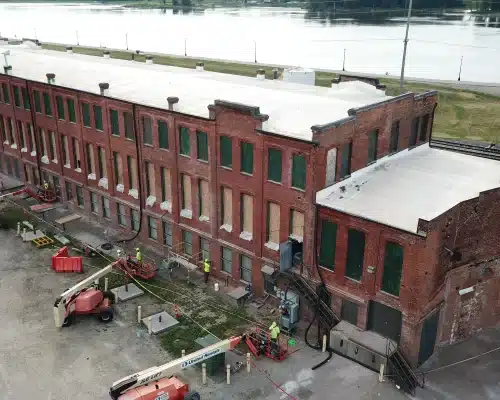
How Bi-State Masonry helped bring a 1907 landmark back to life on an award-winning historic restoration in Muscatine, Iowa.
Proud to Be Part of Iowa’s Top Restoration Project
When the design-build team on the McKee Building restoration was named the recipient of the Master Builders of Iowa Award of Excellence—the event’s highest project honor—it recognized what happens when an owner, a general contractor, a design team, and skilled trades all pull in the same direction. Bi-State Masonry was proud to be the masonry trade partner on that project, restoring the century-old brick of one of Muscatine’s most recognizable landmarks. The former McKee Button Factory, built in 1907 on the banks of the Mississippi, could easily have been torn down. Instead, it was saved—and much of what visitors see today is the same brick that has stood for more than a hundred years, brought back to life joint by joint.
About the McKee Button Factory
The McKee Button Factory has been part of Muscatine’s identity for well over a century. Built in 1907 along the Mississippi River at 1000 Hersey Avenue, it was once the largest freshwater pearl button factory in the world—a fitting distinction for the city known as the “Pearl Button Capital of the World.” For decades, hundreds of workers lined its long, window-filled walls, shaping clamshells harvested from the riverbed into pearl buttons that were shipped across the country.
Button production eventually gave way to plastics, and the McKee family closed the factory and sold the building in 2020. That same year, the building earned a place on the National Register of Historic Places, cementing its status as a piece of Muscatine history worth protecting. When Kent Worldwide (formerly Kent Corporation) acquired the property, the company committed to preserving the building’s historic character while giving it a modern purpose as office space. You can read more about the building’s history and Kent’s vision in Kent’s own account of the project and in local coverage of the restoration.
Preserving a building like this is a serious undertaking. A structure that has stood since 1907 carries a century of wear in its walls—and before it could become the modern headquarters it is today, the masonry itself had to be made sound again. That’s where our work began.
A Century of Iowa Weather
More than a hundred years on the banks of the Mississippi takes a toll on brick and mortar. The McKee Building had weathered decade after decade of the same harsh conditions we see across the Quad Cities—brutal freeze-thaw cycles, temperature swings, and constant moisture rising off the river. Water is the enemy of masonry, and given enough time it finds every weakness.
By the time restoration began, the building was in rough shape. Mortar joints had eroded and washed out across large sections of the facade. Brick had spalled and cracked where moisture had gotten in and frozen. And most seriously, the building had developed genuine structural problems—areas where the masonry had shifted, cracked, and weakened to the point that it needed far more than a cosmetic touch-up. This wasn’t a building that needed tidying. It needed a comprehensive masonry restoration by a crew that knew how to handle historic structural work.
Our Masonry Restoration Work
The McKee Building called on nearly every masonry restoration service we offer. A project like this can’t be rushed or approached piecemeal—the work has to move in the right order, from structural stabilization through to the finishing details, so that every repair supports the next. Here’s what our crews took on.
Structural Rebuilding
We started where it mattered most: the building’s structural integrity. Over a century, portions of the masonry had shifted and deteriorated to the point that they no longer did their job of holding the building together. Our crews rebuilt and stabilized these compromised sections, carefully taking down and reconstructing masonry where necessary while preserving the building’s original appearance. This is the kind of work that doesn’t show in the finished photos—but it’s the reason the building will stand for another century.
Tuckpointing and Repointing
With the structure sound, we turned to the mortar joints—and there were a lot of them. The McKee Building required extensive tuckpointing and repointing across its facade, removing failed, crumbling mortar and packing the joints with fresh material. On a historic building, this is more involved than it sounds. Modern mortar is typically too hard for old brick; it doesn’t flex the way softer historic mortar does, and over time a mismatch can actually damage the very brick you’re trying to save. We matched our mortar to be compatible with the 1907 masonry so the repairs work with the building rather than against it.
Brick Replacement
Where brick had deteriorated beyond saving, we replaced it—but replacement on a historic building is a matching exercise as much as a masonry one. We sourced brick to match the original in color, size, and texture so the repairs blend into the surrounding wall instead of standing out. Done right, you shouldn’t be able to tell where the century-old brick ends and the replacement begins.
Lintel and Sill Work
A factory built for natural light means windows—more than 200 of them—and every one has a lintel above it and a sill below. These are classic failure points in old masonry buildings: lintels corrode and expand, sills crack and let water in, and the surrounding brick suffers as a result. We restored and rebuilt lintels and sills throughout the building, addressing a common source of water infiltration and protecting the extensive window restoration happening alongside our work.
Masonry Cleaning
Finally, we cleaned the historic brick—carefully. A century of grime, staining, and buildup had dulled the facade, but aggressive cleaning can permanently damage historic masonry. Using appropriate methods for the age and condition of the brick, we brought the facade back to life without harming the material we’d worked so hard to preserve, revealing the character that had been hiding under decades of weathering.
A Team Effort: Iowa’s Top Construction Honor
In early 2026, the McKee Building restoration received the Master Builders of Iowa Award of Excellence—the top project honor at the organization’s annual awards. The recognition went to Russell, which led the design-build historic renovation for Kent Worldwide, transforming the former button factory into modern office space while preserving its historic character.
We want to be clear about our role, because we think the honest version is the better story: Bi-State Masonry didn’t win this award. Russell did, as the design-build contractor that led the project. But a restoration of this scale is only as good as the trades that execute it—and when Russell announced the honor, the company named its trade partners publicly, Bi-State Masonry among them. Being credited by name by the general contractor that earned Iowa’s top building honor means a great deal to our crew. We were proud to be the masons on this one.
Great restoration work is genuinely collaborative. It takes a committed owner willing to save a building rather than replace it, a general contractor who can coordinate dozens of moving parts, a design team that understands historic preservation, and skilled trades who can do the hands-on work to the standard the building deserves. On the McKee project, we were glad to work alongside a talented group of fellow trade partners, including Shive-Hattery, Tri-City Group, Allied Construction, Ryan & Associates, Prime Construction Services, Wadsworth Construction, Pearl City Wood Products, and D&N Hardwood Flooring. The building’s new roof was installed by Riddell Roofing, a fellow Quad Cities contractor.
This isn’t the first award-winning restoration our masons have contributed to. We were also proud to earn recognition for our historic masonry restoration on the University of Iowa Chemistry Building—a project that, fittingly, also brought us together with Shive-Hattery. Historic preservation is a specialty we’ve built over more than 26 years, and being trusted on landmark buildings like these is something we don’t take lightly.
The Result
Today the building has a new name and a new life. Renamed McKee Plaza, it serves as headquarters for Kent Worldwide’s Consumer Brands Division, with dozens of employees working where pearl buttons were once made. The roof, floors, plaster, and windows have all been restored, and the building overlooks the same Mississippi River it has watched for more than a century.
But look at the brick, and you’re looking at 1907. The facade that greets visitors is largely the original masonry—not a modern replica, but the actual brick of the McKee Button Factory, made sound and beautiful again. That’s the quiet satisfaction of restoration done right: the best masonry work doesn’t announce itself. It simply looks like it has always been there, because it has. The McKee Building is secure for another generation, its historic character intact, and we’re proud that our work is part of why it’s still standing.
Frequently Asked Questions
What is the McKee Button Factory?
The McKee Button Factory is a historic building in Muscatine, Iowa, built in 1907 on the banks of the Mississippi River. It was once the largest freshwater pearl button factory in the world, part of the industry that earned Muscatine its nickname as the “Pearl Button Capital of the World.” The building was added to the National Register of Historic Places in 2020 and has since been restored into modern office space known as McKee Plaza.
Did Bi-State Masonry win the Master Builders of Iowa award?
No—and we’re happy to be clear about that. The Master Builders of Iowa Award of Excellence went to Russell, the design-build contractor that led the McKee Building restoration. Bi-State Masonry was the masonry trade partner on the project, and Russell named our company by name among its trade partners when it announced the honor. We were proud to contribute the masonry work on an award-winning historic restoration.
How do you match mortar and brick on a historic building?
Matching is one of the most important parts of historic masonry restoration. For mortar, we analyze the original material and formulate a compatible mix—historic buildings need softer mortar than modern construction, because mortar that’s too hard can actually damage old brick over time. For brick, we source replacement units that match the original in color, size, and texture. The goal is repairs that blend seamlessly with the existing wall rather than standing out.
Can old, deteriorated brick really be saved instead of replaced?
In most cases, yes. A great deal of historic masonry can be preserved through repointing, structural stabilization, and targeted repairs, with full brick replacement reserved only for units that are too far gone. On the McKee Building, much of the facade you see today is the original 1907 brick—restored rather than replaced. Saving original material preserves both the building’s historic character and its value.
Does Bi-State Masonry do historic restoration for other commercial buildings?
Yes. Historic and commercial masonry restoration is one of our specialties. We’ve worked on universities, schools, government buildings, and commercial properties throughout Illinois and Iowa, including award-recognized projects like the McKee Building and the University of Iowa Chemistry Building. Whether a structure needs comprehensive restoration or targeted repairs, our crews bring the experience that historic preservation demands.
Trust Your Historic Building to Bi-State Masonry
Is your historic or commercial building showing signs of masonry deterioration? Crumbling mortar joints, spalling brick, water infiltration, failing lintels, or structural cracking all point to problems that only get worse—and more expensive—if they’re ignored.
Bi-State Masonry brings restoration experience to every project, from small repairs to landmark buildings. We serve commercial clients from Des Moines to the greater Chicago area and residential customers within 50 miles of the Quad Cities, and we’re licensed and insured in both Iowa and Illinois. As a merit shop, we keep our overhead low and pass the savings to you—commercial-grade craftsmanship at competitive rates.
Bi-State Masonry offers free estimates on all residential and commercial work. Contact Bi-State Masonry to discuss your restoration or masonry project, or call us at (309) 786-8800.