
Hollow Metal Door Frame Installation in Masonry Construction
Properly installed door frames are critical to the security, functionality, and fire safety of any commercial building. At Bi-State Masonry, we specialize in the precise installation of hollow metal door frames within masonry wall construction, working with CMU block, brick, and concrete substrates throughout the Des Moines to Chicago corridor. Since 1999, we have installed countless commercial door openings for schools, government facilities, warehouses, industrial plants, and corporate buildings across Iowa and Illinois.

Masonry Door Frames for Commercial Construction
Commercial masonry door frame installation requires precision and expertise that differs significantly from standard drywall applications. When door frames are integrated into block walls, brick construction, or concrete masonry units (CMU), the installation must be coordinated with the masonry work itself. Our crews understand the timing, anchoring requirements, and construction sequencing necessary to achieve secure, properly aligned door openings that will function correctly for decades.
Hollow metal frames used in masonry construction are typically fabricated from 16-gauge galvannealed steel and designed to accommodate wall thicknesses common in commercial buildings. These frames are available in welded assemblies for new construction or knocked-down (KD) configurations for retrofit applications in existing masonry walls. We work with both types and select the appropriate frame style based on project requirements and wall conditions.
Types of Commercial Door Frames We Install
Our commercial door installation services encompass the full range of hollow metal frame configurations used in masonry construction:
- Welded hollow metal frames for new CMU and block wall construction
- Knocked-down (KD) masonry frames for existing wall applications
- Fire-rated frames with ratings up to three hours
- Frames with sidelites and transoms for entrance applications
- Heavy-duty frames for high-traffic industrial and institutional settings
- Specialty frames for oversized openings and double-door configurations
The Door Frame Installation Process
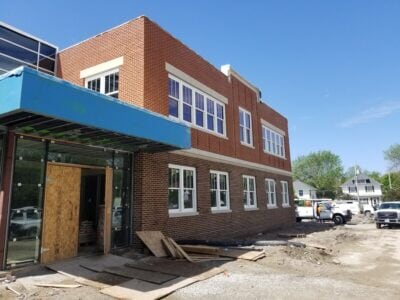
Installing commercial door frames in masonry construction is a multi-day process that must be carefully coordinated with the block laying sequence. Unlike drywall applications where frames can be installed after walls are complete, masonry door frame installation happens simultaneously with wall construction. This requires our masons to work methodically, maintaining frame alignment while anchoring the frame at precise intervals as the wall rises.
Pre-Installation Preparation
Before any masonry work begins, we verify that the frame specifications match the project drawings, including handing, hardware preparations, and reinforcements. We confirm hinge size, strike type, and closer mounting locations. The rough opening dimensions are verified against the frame requirements, with masonry openings typically requiring the nominal door width plus four and one-half inches and the nominal height plus two and one-quarter inches to accommodate anchoring and alignment.
Frame Setting and Alignment
We position the frame at the door opening location using precisely cut spreader bars placed between the hinge and strike jambs at floor level. These spreaders must be cut squarely and accurately, as they establish the jamb alignment critical to proper door operation. Base anchors are secured to the floor on each jamb using concrete screws or drive pin anchors, and the frame is carefully checked against layout lines before masonry work proceeds.
Masonry Integration
As the block wall is constructed around the door frame, anchors are placed at intervals of approximately 24 to 30 inches of jamb height. On the hinge jamb, each anchor is located immediately above or below each hinge reinforcement. Strike jamb anchors are positioned directly opposite the hinge jamb anchors. Throughout the process, we continuously check the frame for plumb, level, and square, making adjustments as needed before the mortar sets.
After laying eight or nine courses of block, the masonry is typically allowed to set overnight with spreaders and temporary bracing in place. Before leaving the site, our crews clean any mortar from hinge pockets and strike reinforcements to ensure hardware can be properly installed later. On the second day, jambs are filled with mortar and additional anchors are set as the wall reaches full height. The frame head is filled with mortar and supported with vertical bracing to prevent sagging until the lintel is set.
Anchor Types and Applications
The anchoring system is essential to secure door frame installation in masonry construction. Different anchor types are suited to specific wall conditions and frame configurations. Our experience with various anchoring methods allows us to select the right approach for each project.
Wire Anchors
Wire anchors are commonly used in CMU and block wall applications. Typically made from three-sixteenths inch diameter wire approximately ten inches long, these anchors lay horizontally between the frame's rabbet and backbend. Wire anchors are designed to expand to accommodate varying frame jamb depths and work well in a wide range of masonry applications.
T-Anchors
T-anchors are manufactured from 16-gauge steel, roughly the width of the door jamb minus one-quarter inch, with a length of approximately ten inches. These anchors lay horizontally against the frame's backbend and provide substantial holding power for heavy-duty applications.
Strap Anchors
Strap anchors, made from 16-gauge steel approximately two inches wide by ten inches long, are typically slotted and connected to a spot-welded tab on the back of the frame. These are commonly used for both new construction and retrofit applications where different anchoring methods may be required.
Masonry Sleeve Anchors and Expansion Bolts
For knocked-down frames installed in existing masonry walls, we use masonry sleeve anchors or expansion bolts. These allow secure attachment to hardened block or brick without requiring integration during wall construction. Frames are punched and dimpled to accept these fasteners, providing a solid connection to the existing substrate.
Fire-Rated Door Frame Installation
Many commercial buildings require fire-rated door assemblies to meet building code requirements and protect occupants during emergencies. Fire-rated hollow metal frames are available with ratings from 45 minutes up to three hours, depending on the application and local code requirements. Our crews are experienced in installing fire-rated assemblies that maintain their certification and comply with NFPA 80 guidelines and Steel Door Institute standards.
Fire-rated installations require particular attention to hardware reinforcements, anchoring intervals, and proper grouting to ensure the frame assembly will perform as designed during a fire event. We verify that all components, including the frame, door, and hardware, are compatible and properly labeled for the required fire rating. Proper installation documentation is maintained for building inspections and code compliance.
Code Compliance and Standards
Commercial door installations must comply with applicable building codes, including the International Building Code and any state or local modifications. Our work meets the requirements of ANSI A250.8 (SDI 100) for hardware preparations and reinforcements. We coordinate with general contractors and building inspectors to ensure all door frame installations pass inspection and meet project specifications.
For governmental projects in Illinois, we understand prevailing wage requirements and work within those parameters. Our merit-based workforce delivers quality craftsmanship at competitive rates, whether the project requires prevailing wage compliance or not.
Commercial and Industrial Applications
Since 1999, Bi-State Masonry has completed commercial door frame installations across a wide range of building types throughout Iowa and Illinois. Our experience spans government facilities, municipal buildings, K-12 schools, universities, corporate offices, warehouses, manufacturing plants, and utility infrastructure. We've worked with institutions like the University of Iowa, Iowa State University, and the Iowa Department of Transportation, demonstrating our capability for institutional-quality work.
Sectors We Serve
- Government buildings
- Municipal facilities
- K-12 schools
- Colleges and universities
- Corporate offices
- Warehouses and distribution centers
- Manufacturing plants
- Utility and infrastructure
Our commercial division handles projects ranging from single door replacements to large-scale new construction with dozens of openings. We work directly with general contractors and construction managers, coordinating our masonry scope with other trades to maintain project schedules. With lower overhead than many regional competitors and a skilled workforce, we deliver quality commercial door frame installations at fair and reasonable prices.
Service Area
For commercial masonry work including door frame installation, we serve the corridor from Des Moines through the Quad Cities to the greater Chicago area. Our central location in East Moline, Illinois allows us to efficiently mobilize crews throughout this region. We have the capacity and experience to handle projects of any size, from local municipal work to major institutional construction.
Frequently Asked Questions
What is the rough opening size needed for a commercial door frame in masonry?
For masonry construction, the rough opening should be the nominal door width plus four and one-half inches and the nominal door height plus two and one-quarter inches. For example, a three-foot by seven-foot door frame requires a rough opening of forty and one-half inches by eighty-six and one-quarter inches. This additional space accommodates anchoring, alignment adjustments, and grout fill around the frame.
How long does commercial door frame installation take in masonry construction?
Installing door frames in new masonry construction is typically a multi-day process. The frame is set and anchored as the block wall is built up around it, with anchors placed at intervals of 24 to 30 inches. After eight or nine courses, the masonry usually needs to cure overnight before the wall is completed to full height. The exact timeline depends on the number of openings and overall project scope.
What fire ratings are available for commercial hollow metal door frames?
Hollow metal door frames for masonry construction are available with fire ratings ranging from 45 minutes to three hours. The required rating depends on the building occupancy type, wall assembly rating, and local code requirements. Fire-rated assemblies must use compatible frames, doors, and hardware that are all labeled for the same fire rating.
Can door frames be installed in existing masonry walls?
Yes. Knocked-down (KD) hollow metal frames are designed specifically for installation in existing block or brick walls. These frames arrive in three pieces and are secured to the existing masonry using sleeve anchors or expansion bolts through punched and dimpled holes in the jambs. KD frames can be installed after the wall is complete, making them suitable for renovations and retrofit projects.
What types of anchors are used for masonry door frame installation?
Common anchor types include wire anchors, T-anchors, and strap anchors for new construction where the frame is installed as the wall is built. For existing wall applications, masonry sleeve anchors and expansion bolts are used. The anchor type is selected based on wall conditions, frame configuration, and project requirements. Anchors must be placed at proper intervals to meet code requirements and ensure secure installation.
Does Bi-State Masonry provide free estimates for commercial door frame installation?
Yes. Bi-State Masonry provides free estimates for all commercial masonry work, including door frame installation. Contact us with your project details and we will review the scope and provide a competitive quote. We work throughout the Des Moines to Chicago corridor and have the experience to handle projects of any size.
Request a Free Estimate
Whether you are planning new commercial construction or need door frame installation in an existing masonry building, Bi-State Masonry has the expertise to deliver quality results. With more than 26 years of experience serving Iowa and Illinois, we understand the requirements of commercial masonry construction and work efficiently to meet project schedules and budgets.
Contact Bi-State Masonry today at (309) 786-8800 or request a free estimate online. Our team is ready to discuss your commercial door installation needs and provide a competitive quote for your project.